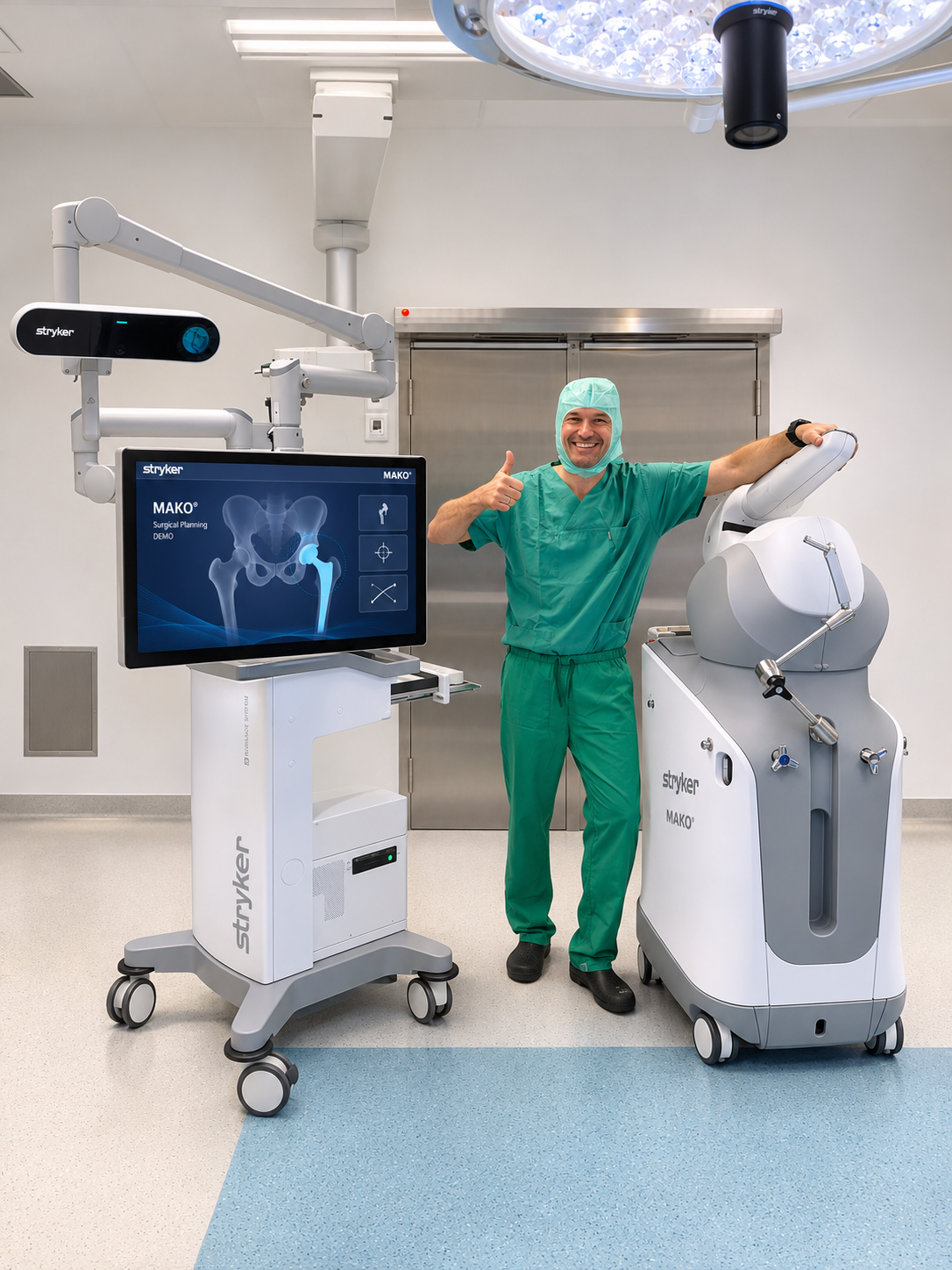
Does the robot perform the operation?
No. A surgical robot is a precision tool, not a replacement for the surgeon. The surgeon performs the operation and makes every decision; the robot does not move independently.
The joint is measured before or at the start of surgery to plan implant size, position and alignment. During surgery, the system guides or limits instruments, takes ongoing measurements and alerts the surgeon to deviations.
What can robotics offer?
- Studies show that implants are positioned more accurately and consistently on average with robotic assistance. We see the greatest benefit in altered anatomy.
- Planning tailored to your anatomy
- Removing only the necessary bone and protecting ligaments and soft tissues
- Measuring knee ligament tension in flexion and extension before bone cuts
- Checking leg length, socket position and joint balance during surgery
- For knee surgery, evidence suggests less pain in the first days and an earlier return to daily activities
Robotics supports an experienced surgeon; it does not replace experience. Whether robot-assisted replacements last longer still requires long-term evidence. We use robotics where it offers a benefit, not for every operation.
Why two systems?
Mako uses a CT-based 3D model and directly constrains the saw or reamer at the bone. This is particularly useful for precise partial knee replacement, patellofemoral replacement and complex hip anatomy.
For the knee, ROSA does not require a preoperative CT. For the hip, it uses X-rays taken during surgery and is compatible with the anterior approach we routinely use.
We discuss system selection with you on the basis of your findings.
Robotics for the hip
Socket position affects stability, range of motion and wear. Robotics helps position the cup at the planned angle and check leg length and offset during surgery.
- Hip dysplasia or previous pelvic surgery
- Hip deformity after childhood conditions such as Perthes disease or slipped capital femoral epiphysis, or after injury
- Spinal fusion, where cup positioning needs particular care
- Significant differences in leg length
Partial knee replacement
If wear affects only the inner or, less commonly, outer compartment of the knee, a partial replacement may be sufficient. It replaces the worn compartment while retaining the cruciate ligaments, kneecap and healthy joint surfaces.
Compared with total knee replacement, it can feel more natural, involve a smaller operation with less blood loss and allow better mobility and faster recovery.
Requirements include wear limited to one compartment, an intact anterior cruciate ligament, no major deformity and no inflammatory joint disease. Small positioning or ligament-balance errors can cause pain or early wear; this is where robotic precision is valuable. Our experience with Mako partial knee replacement in Greifswald convinced us of the value of robotics.
Patellofemoral replacement
Sometimes arthritis affects only the joint between the kneecap and thigh bone. Typical symptoms include pain behind the kneecap on stairs, standing from sitting, squatting or walking downhill. It often affects women aged 40–60 with longstanding kneecap problems or trochlear dysplasia.
Only the groove on the femur and the back of the kneecap are replaced; the rest of the knee is preserved. Wear must be limited to this compartment, without significant arthritis elsewhere or inflammatory joint disease.
Mako's 3D planning supports precise groove alignment so the kneecap tracks correctly. If arthritis later develops elsewhere, conversion to a total knee replacement is possible.
Total knee replacement
If the whole knee is worn, all joint surfaces are replaced. Robotic planning considers implant position and collateral ligament tension in both flexion and extension. Joint balance is measured and the plan adjusted before bone is cut.
The aim is stability throughout movement without making the knee too tight. Around one in five patients is dissatisfied after conventional total knee replacement; more precise alignment and ligament balance aim to reduce that proportion.
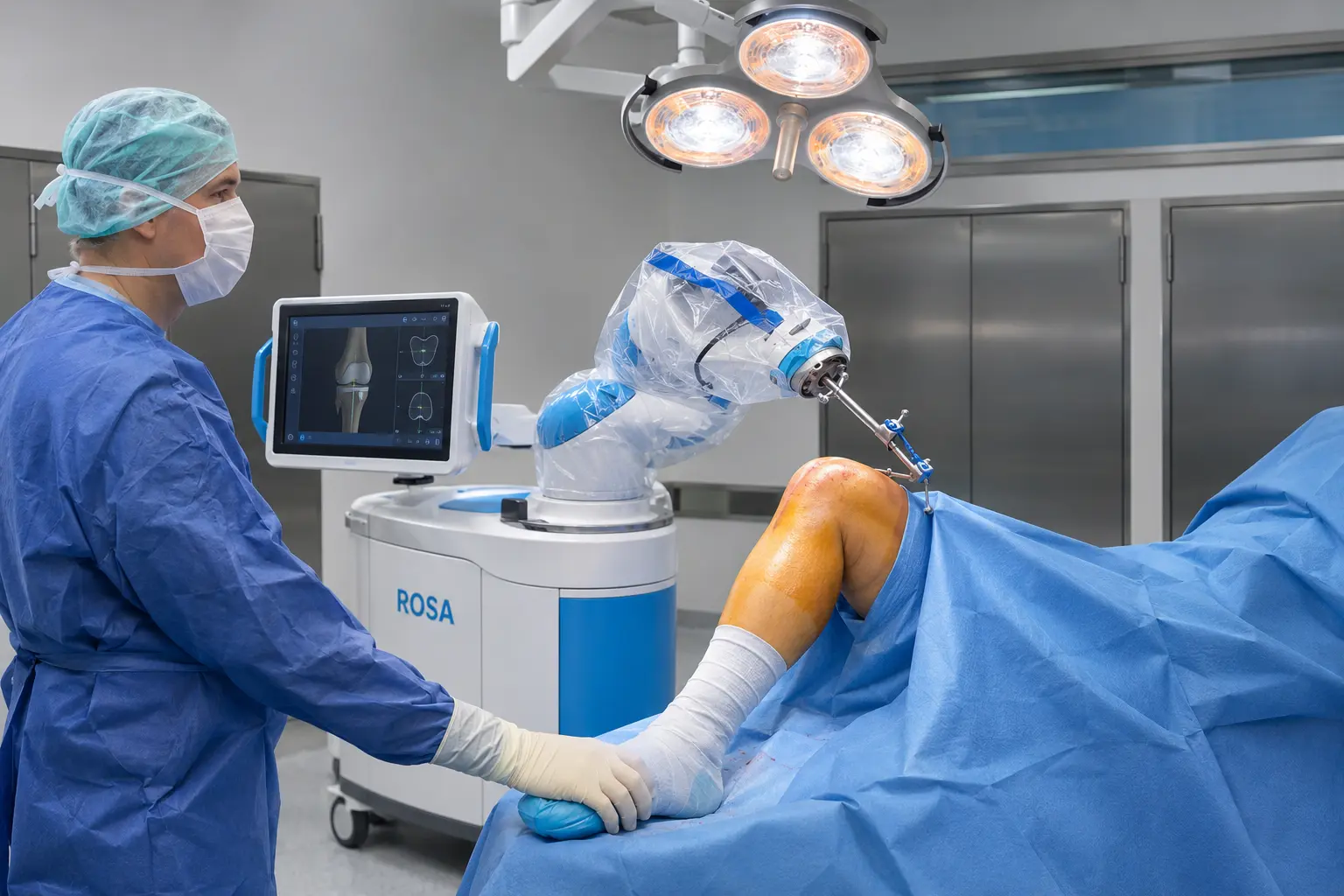
Preparation and aftercare
- Mako requires a preoperative CT of the leg with a low radiation dose; ROSA uses X-rays or no additional imaging for knee planning.
- Getting up on the day of surgery, usually with full weight-bearing.
- Hospital stays for partial and patellofemoral replacement are generally shorter than for total replacement.
- Physiotherapy focuses on knee extension and flexion.
Frequently asked questions
+Does the robot operate alone?
No. The surgeon performs each step; the robot helps keep instruments within the planned area.
+Is there an additional charge?
No. Robot-assisted surgery is part of the treatment.
+Does the operation take longer?
Initially it can take slightly longer; with experience the difference becomes small.
+Does every hip replacement need a robot?
No. With normal anatomy, experienced surgeons achieve very precise implant positioning without a robot. We use robotics where it provides a real benefit.