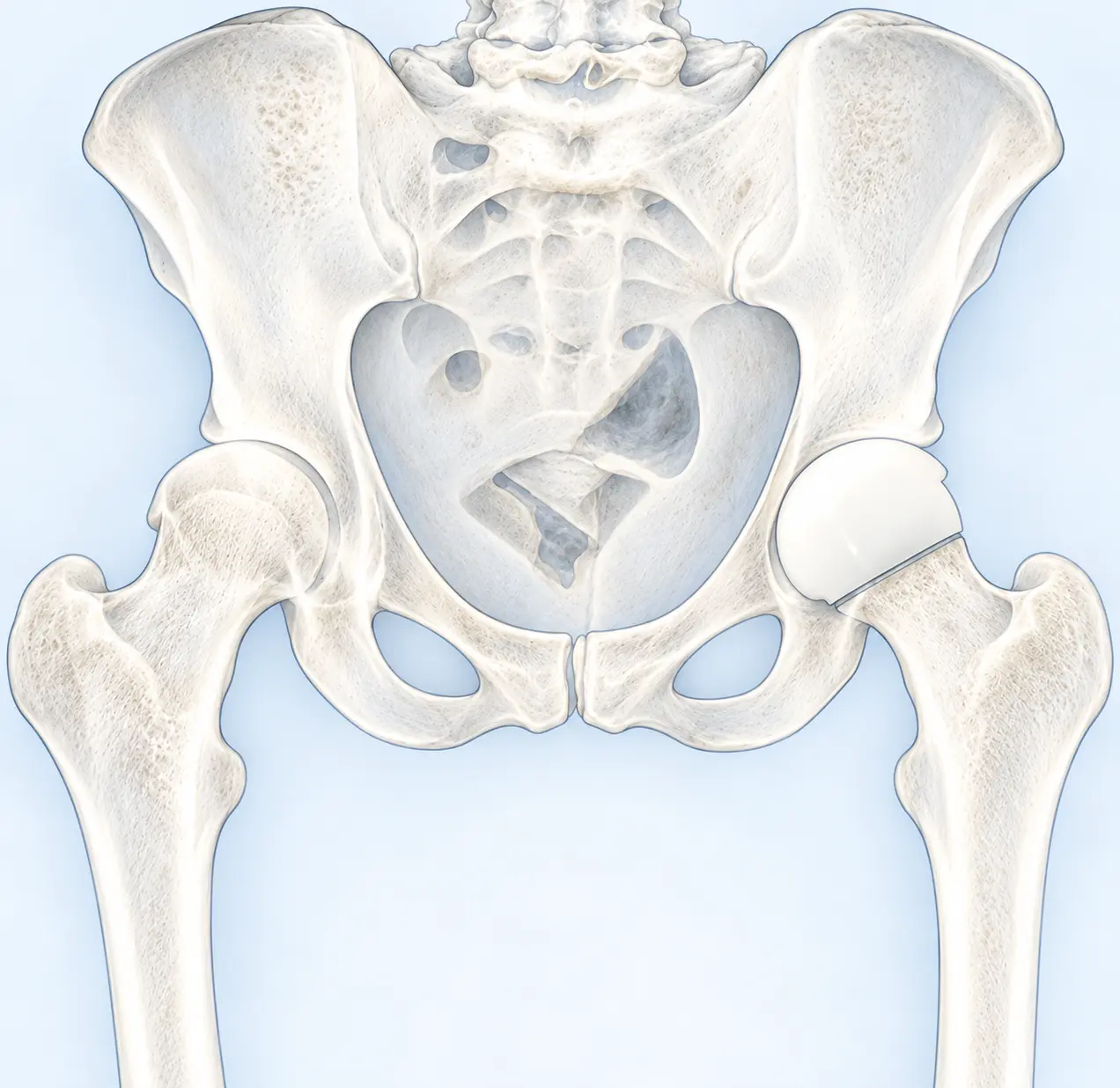
The anterior approach: between the muscles
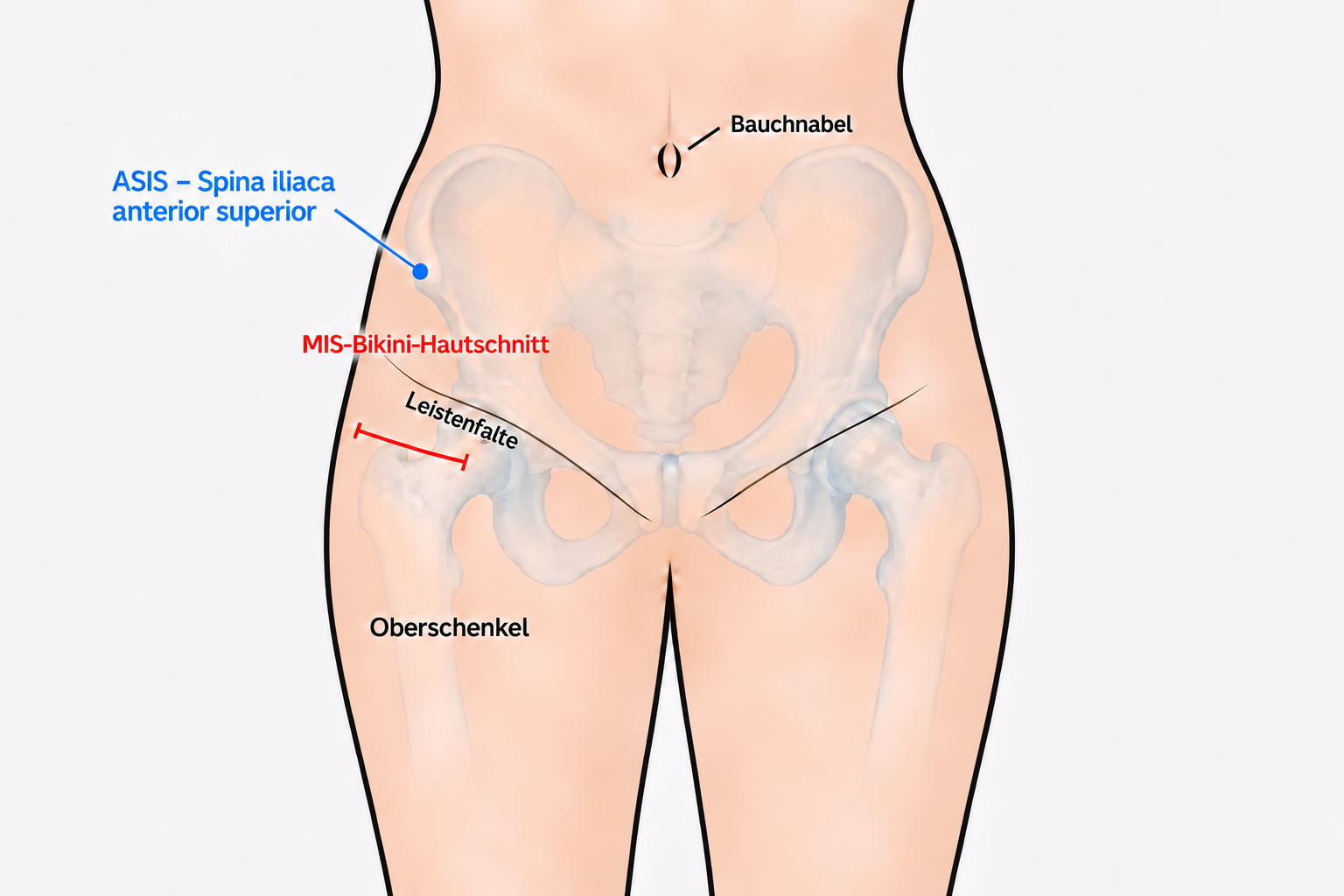
The hip can be reached from behind, from the side or from the front. The approach passes through a natural interval between the muscles without detaching muscles or tendons. The most common side effect is numbness on the outer thigh caused by irritation of a skin nerve (the lateral femoral cutaneous nerve). It usually resolves. The skin incision runs obliquely in the groin crease – it is therefore also called the “bikini incision” and is barely visible later. For you this means:
- Up on your feet sooner: in a comparison study, patients walked without a rollator after an average of 10 days following the anterior approach – after the approach from behind only after 15 days.
- Less muscle damage: MRI shows damage to the gluteal muscles markedly less often.
- A stable joint: the risk of dislocation is less than half as high as with the approach from behind – large registers from Australia and the Netherlands confirm this.
- Equal leg lengths: you lie on your back. This allows us to compare leg length directly with the other side and to check it with an X-ray taken in the operating theatre.
Why we operate this way – and when we do not
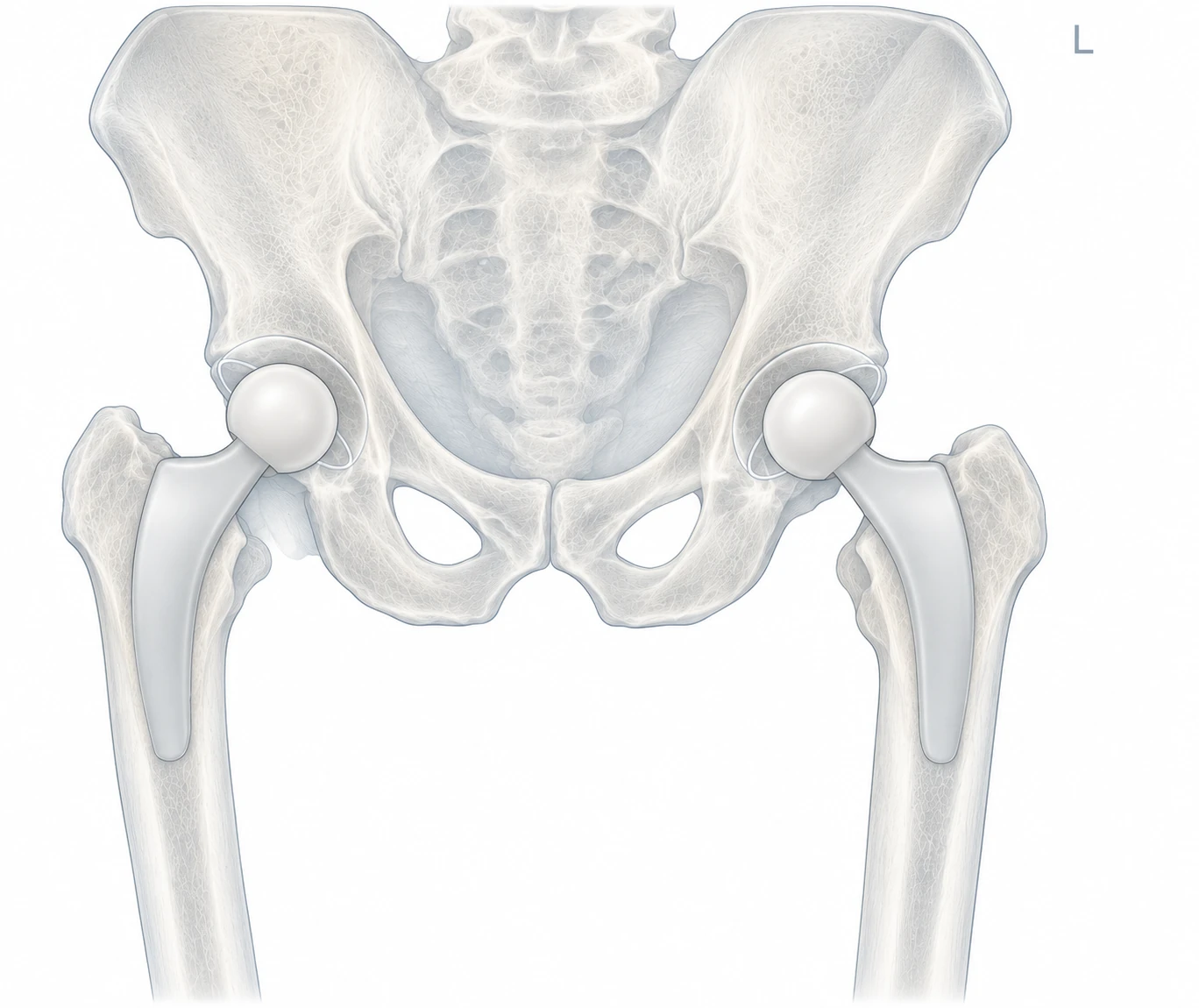
For most patients we use the same combination: the anterior approach with an instrument set developed for it, a short femoral stem and a one-piece elastic cup (OptiHip instrument set, optimys short stem, RM Pressfit vitamys cup). The reason is simple: each of these three components preserves tissue or bone, and they fit together technically.
The approach: muscles and tendons stay untouched
With the anterior approach the thigh bone is difficult to reach. Parts of the joint capsule and tendons on the thigh bone therefore often have to be detached. With special hooks and a lifter that we developed together with colleagues, the bone can be positioned without this detachment.
The stem: as little bone as possible
A straight standard stem reaches far into the thigh bone. With the anterior approach it can only be inserted if the bone is levered far out. The short stem is curved. It follows the natural course of the bone and anchors only in its upper section, and that is what makes it fit the path the anterior approach prescribes. The rest of the thigh bone remains untouched.
The cup: the bone behind it is preserved
A metal shell is considerably stiffer than bone. Force is therefore transferred unevenly, and the bone behind the cup can break down over the years. The cup we use consists of one piece of plastic with a titanium coating and is as elastic as bone. In a comparison study, markedly less bone was lost behind this cup than behind a metal shell. Because shell and insert are not separate, one possible source of wear is also eliminated.
Bearing: as standard, a ceramic head articulates with a cup made of vitamin-E-stabilised polyethylene. We use ceramic-on-ceramic bearings for ceramic hip resurfacing.
The results
The EPRD Annual Report 2024 reports an eight-year cumulative failure probability of 2.1% for optimys/RM Pressfit vitamys. For elective total hip replacements with a cementless stem, the comparison figure is 4.3%. These are registry data from different patient groups, not a direct comparison of effectiveness. Source: EPRD Annual Report 2024, Tables 46 and 47.
Why this counts especially in young patients
Anyone who receives an artificial hip at 30, 40 or 50 will most likely not keep it for life. At some point a revision becomes necessary. How well that revision succeeds depends above all on how much of your own bone is still there. We therefore pursue three goals in the first operation: remove as little bone as possible, preserve the bone around the implant and leave muscles and tendons intact.
This applies especially to osteoarthritis following hip dysplasia, the most common cause of hip osteoarthritis in young people. In dysplasia the socket is flat and the bone at its rim is often thin. The thigh bone is frequently narrow and more twisted than normal. For these hips the following applies:
- The cup must sit where enough load-bearing bone is present. Removing as little additional bone as possible is particularly important here.
- The short stem can also be inserted into a narrow thigh bone and restores leg length and muscle tension.
- If the anatomy is more strongly altered, we additionally plan the operation with the robotic arm (Mako) on a 3D model. We then use the implants provided for this system.
When we do things differently
This combination is our standard, but it is not suitable for every hip. We choose other implants or techniques, among others:
- in severe dysplasia with the femoral head displaced far upwards or a marked malalignment of the thigh bone,
- in clearly reduced bone quality (osteoporosis), where a cemented stem can be safer in older patients,
- after previous operations with implants in place or clearly altered anatomy.
Which approach is right for your hip we determine together with you after examination and evaluation of your X-rays.
More on the hip replacement with robotic-arm support (Mako)Ceramic surface replacement
For active women and men with good bone quality, ceramic hip resurfacing may be an option – fitness and bone quality, not age, are decisive. Only the worn surface of the femoral head and the socket is replaced. The femoral neck and most of the femoral head are preserved.
We use a ceramic surface replacement. Earlier surface replacements made of metal had problems because of metal wear – that risk does not exist with ceramic.
- Surgery through the anterior approach
- Operation time: about 60–90 minutes
- Hospital stay: 3–5 days
Ceramic surface replacements are a more recent development. Long-term results over many years are not yet available to the same extent as for the standard replacement. Whether it is the right choice for you, we decide together with you.