
At a glance
- For selected active women and men with hip osteoarthritis and good bone quality
- Operating time: approximately 60–90 minutes through a muscle-sparing anterior approach
- Hospital stay: 3–5 days
- Cycling and swimming after around six weeks; running, jumping and ball sports from month 7
Recovery and return to sport depend on your bone quality, surgical findings and individual progress; these timings are not guarantees.
Ceramic resurfacing in Greifswald
Ceramic hip resurfacing was introduced in Greifswald in March 2026. It adds an option for selected patients when preserving the natural joint is no longer appropriate.
How does it differ from a total hip replacement?
A conventional hip replacement removes the femoral head and places a stem in the thigh bone. Resurfacing retains the femoral head and neck, fitting a ceramic cap over the head much like a crown over a tooth. No stem is inserted into the femur; the cap has a short peg within the femoral head.
- More of your own bone is preserved.
- The large head follows your natural anatomy and may contribute to stability, although dislocation cannot be ruled out.
- Your hip shape is largely preserved; leg length is considered during planning.
- If revision is needed later, conversion to a conventional hip replacement is usually possible.
An example from our clinic
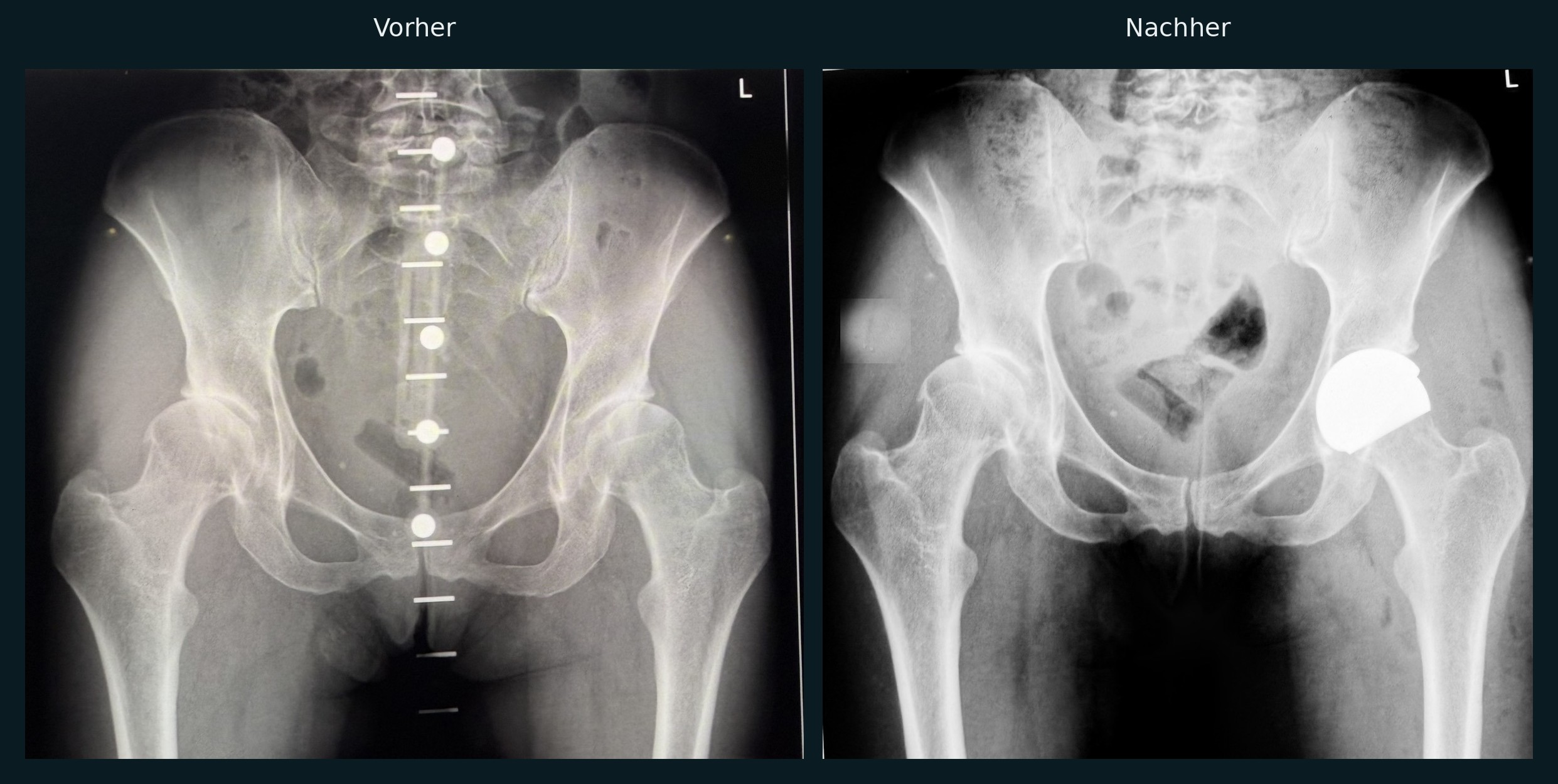
A 40-year-old woman with advanced hip osteoarthritis and high activity demands received ceramic hip resurfacing. Her preoperative X-ray shows loss of cartilage and narrowing of the left joint space.
The postoperative image shows the retained femoral head and neck with a ceramic cap replacing the joint surface. She can bear weight from the start and gradually rebuild sporting activity.
Ceramic rather than metal-on-metal
Earlier resurfacing systems used metal-on-metal bearings, which could release metal wear particles and ions and cause local tissue reactions. Ceramic resurfacing has two ceramic bearing surfaces: the cap moves inside a matching ceramic shell.
This avoids a metal-on-metal bearing, but it does not eliminate risk. Ceramic can produce noise and can rarely fracture.
- No metal-on-metal contact at the bearing
- Very low ceramic wear
- The ceramic material has also been used in conventional hip replacements for many years
Who is suitable?
Ceramic resurfacing can be suitable for active people with hip osteoarthritis, including arthritis caused by hip dysplasia. Bone quality and overall fitness matter more than age alone.
Women and smaller hips are not automatically excluded; small implant sizes are available.
It is not suitable when bone is too weak because of osteoporosis or the femoral head is extensively damaged. We assess your X-rays together and recommend a conventional replacement if that is the better option.
The operation
- Direct anterior approach (DAA): muscles are moved aside rather than detached.
- Detailed individual planning, with particular attention to implant positioning.
- Operating time: approximately 60–90 minutes.
- Hospital stay: 3–5 days.
After surgery
You may bear weight from the start as pain allows. Running and jumping are delayed while the bone adapts to the implant.
- Weeks 1–6
- Protection: wound healing, mobility, walking with crutches, everyday movements and home exercises.
- Week 7 to month 3
- Strengthening: walking, cycling, swimming and light strength training; restoring balance and reducing a limp.
- Months 4–6
- Progression: hiking, cross-trainer and brisk walking; rebuilding equal leg strength and single-leg stability.
- From month 7
- Return to sport, including running, jumping, tennis, ball sports and skiing, according to your individual recovery.
The femoral neck needs several months to adapt to its new loading. After around six months, the bone is fully load-bearing again. Your surgeon and physiotherapist tailor progression to your bone quality and follow-up findings.
Physiotherapy and follow-up
Physiotherapy supports safe walking, mobility and gradual strengthening. Clinical and X-ray reviews are part of aftercare; you receive your personal follow-up plan on discharge.
Crutches are generally used for 4–6 weeks. Driving is usually possible around six weeks when you can walk safely without crutches. Office work is often possible after 3–6 weeks and heavy physical work after around three months.
New groin pain or a returning limp in the first months should be assessed promptly.
Results and their limitations
- Ceramic hip resurfacing has been used since 2017. In an international study of more than 600 patients, 98% of joints were functioning after five years, with equally good results in women and men. Results at 15–20 years are not yet available. Results from earlier metal systems cannot be transferred.
- Almost one in two patients participates in running or jumping sports two years after surgery.
International findings are not Greifswald's own long-term outcomes, and none of these figures guarantees an individual result.
Risks
- General surgical risks, including infection, thrombosis and bleeding
- A very rare femoral neck fracture, almost always in the first months; conversion to a conventional replacement is then needed
- Loosening of an implant component
- Occasional joint noise and very rare ceramic fracture
- Usually temporary numbness on the outer thigh from irritation of a skin nerve
Frequently asked questions
+How long will resurfacing last?
Results so far are encouraging, but revision may eventually be needed, as with any joint replacement. Conversion to a conventional hip replacement is usually possible.
+Am I suitable as a woman?
Suitability depends on your bone quality and hip shape, not on sex alone.
+Are the bearing surfaces metal?
No. Both bearing surfaces are ceramic.
+What should I do if I have symptoms?
Contact us directly, especially for new groin pain or a returning limp.