If the wound weeps: contact us straight away
A healthy wound is dry and does not weep. Contact us immediately and at any time if the wound weeps, is red, swollen or warm, if the pain increases or you develop a fever.
Please do not act on your own initiative and do not have the wound treated elsewhere on an outpatient basis – no ointments, no antibiotics “on suspicion”, no opening of the wound. Often a photo by email is enough for an initial assessment: Ortho-terminvergabe@med.uni-greifswald.de · telephone 03834 86-7077. Better one update too many than one too few.
Why appearance matters
Many of our patients are young. As well as being pain-free and mobile, how the hip looks afterwards also matters to them. That is a legitimate question, and we take it seriously.
In the past, PAO was performed through a long, curved incision running from the iliac crest well down the thigh. Those scars were often 15 to 20 cm long and clearly visible. That is no longer necessary.
Our bikini approach
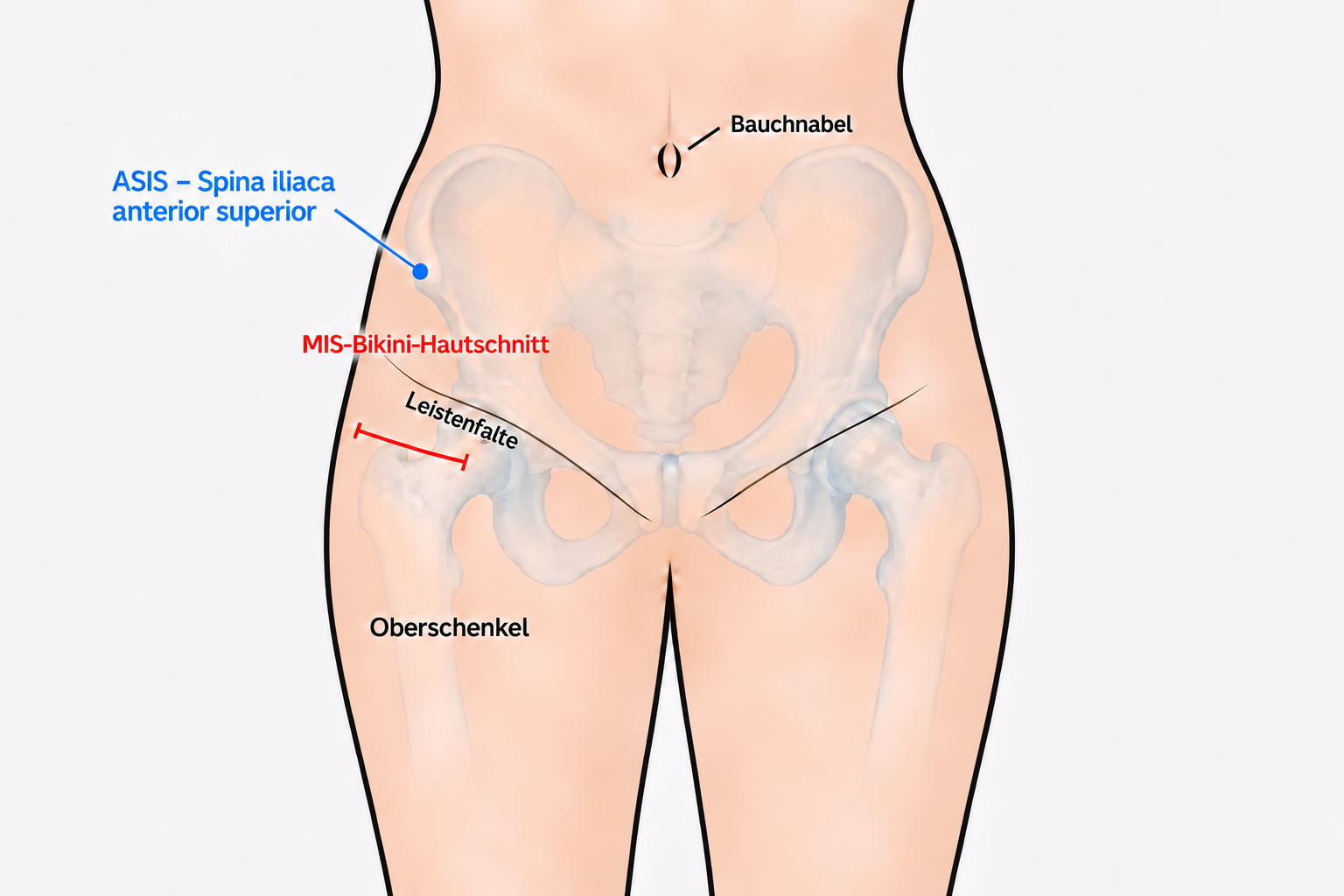
In Greifswald we perform PAO through a short incision of 5–8 cm, depending on body size. The incision lies in the groin fold and runs obliquely, along the natural skin lines. This is the area a bikini or swimming trunks normally covers.
Why the course of the incision matters
Skin has natural tension lines. An incision that runs across these lines is pulled apart with every movement. The scar then often becomes wide, raised and red. An incision along the skin lines, by contrast, is under little tension. The wound edges lie quietly against one another, and the scar usually becomes narrow, flat and pale.
In addition: the skin in the groin fold folds anyway when you sit and walk. A scar there is less noticeable than on a smooth skin surface.
Small incision – full correction
The short incision is no compromise in the operation. Through it we reach the pelvis along a natural gap between the muscles, without detaching muscle. The socket can be positioned just as precisely as through a large approach. If the femoral neck also has to be reshaped, this is done through the same incision.
Good to know: if the thigh bone also has to be rotated in the same operation (needed in about 5 to 10% of our patients), a second small incision on the outside of the thigh is required. We discuss this with you beforehand.
How the scar develops
A scar needs time. It takes 12 to 18 months for it to reach its final appearance.
- Week 1–2
- Wound closed, dressing, slight swelling.
- Week 3–12
- Scar red or pink, sometimes slightly raised – this is normal.
- Month 3–12
- Redness slowly subsides, the scar becomes flatter and softer.
- From month 12–18
- Scar pale, narrow, hardly visible.
Do not be alarmed in the first months: a fresh scar almost always looks more conspicuous than it will later.
In the first two weeks
- Keep the dressing dry and do not change it yourself unless necessary
- No creams, powders or oils on the fresh wound
Once the wound has fully healed (usually from week 3)
Silicone is the most important measure. Silicone gel or silicone sheets are considered first choice in dermatological guidelines for preventing wide, raised scars. Apply them only to a fully closed wound, never to open areas.
- Silicone gel: apply a thin layer twice daily and let it dry
- Silicone sheets: wear for at least 12 hours a day, preferably longer
- Duration: 3 to 6 months – do not stop after a few weeks
- Offload the scar: in the first weeks after healing, a narrow, breathable paper plaster strip applied lengthways over the scar can reduce pull on the wound edges. It combines well with silicone gel (gel first, let it dry).
- Sun protection: in the first year scars can darken permanently in the sun. Cover them or use sunscreen with SPF 50.
- Gentle scar massage: once or twice daily for a few minutes with a moisturising cream (for example with dexpanthenol), using light pressure.
- Avoid friction: do not let a trouser waistband or knickers press directly on the fresh scar. Loose trousers are more comfortable in the first weeks.
Onion extract gels
Products containing onion extract can be used as a supplement. Their benefit is less well established than that of silicone, however. If you use only one product, choose silicone.
If the scar becomes thick anyway
If the scar becomes thicker, harder or itches badly in the first months, get in touch. There are then effective treatments with a dermatologist, for example corticosteroid injections directly into the scar or laser therapy. The earlier, the better.
Frequently asked questions
+Is the skin around the scar numb?
Fine skin nerves are cut in every incision. A small numb or tingling area directly next to the scar is therefore common. In most cases it shrinks over the following months. Different is persistent burning pain on the outside of the thigh – please contact us promptly if that occurs.
+Is the scar visible in a bikini?
With most bikinis and swimming trunks the scar lies completely or largely under the fabric. With very brief or high-cut designs the outer end may be visible. If this matters to you, raise it with us before surgery – we will then plan the incision together with you.
+What if I tend to thick scars?
Some people tend to very thick scars (hypertrophic scars or keloids) – more often with darker skin, and if previous scars have already healed thickly. If you know this about yourself, tell us beforehand. You would then start silicone particularly consistently, we would check the scar at shorter intervals, and if needed we would involve a dermatologist early.
+I have already had hip surgery. Will there be a second scar?
Where possible we use the existing scar. We decide this on a case-by-case basis.
+Can an unsightly scar be corrected later?
Yes. If a scar is wide or bothersome after 12 to 18 months, it can be corrected. With our approach, however, this is rarely necessary.